Upcoming
Dates - 2009
1. March 9th, 2009 - White Plains, NY - CANCELLED
2. March 10th, 2009 - Newark, NJ
3. March 11th, 2009 - Harrisburg, PN
4. March 12th, 2009 - Cherry Hill, NJ
5. March 13th,
2009 - Portland, ME - CANCELLED
Click "Kevin Williams Contact/Information" to get in touch, ask a question, offer comments, or inform me of features or links that aren't working, or if you're interested in having Kevin present for your school/school
district. In addition, you can find out more about Kevin, his family, and feedback from previous seminars.

Assignments, Articles, Images, and Sources To Engage Students (Updated
3/8/09)
Lessons and Assignments
1. Education at HarpWeek.com – I have touted HarpWeek.com for many years, but now they have added an education page.
It appears to be in its infancy – there are only four lessons and they are all “simulations”. However, there are great guiding lessons that utilize the amazing image database of
HarpWeek.com. I think the Reconstruction Convention Simulation is amazing!!
2. Teaching Tolerance - Offers several free videos for educators. I've used them all; particularly useful has been "Mighty Time", and "The
Shadow of Hate". A new video, "Viva La Causa" is coming out. It deals with Cesar Chavez.
4. An American Time Capsule - from American Memory, this excellent site contains three centuries of "broadsides and ephemera". You
and your students can search in multiple ways. Any way you look at it, there is some amazing information here - like
this newspaper page depicting the flow of information following Lexington and Concord.
5. Progressivism PowerPoint Project - we discussed this lesson during the seminar. This is the updated lesson - all research summaries are included.
This should help shorten the length of this assignment. Remember to conclude the assignment with a slideshow exam.
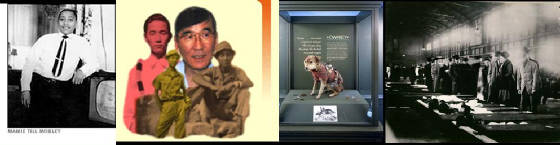
6. Manzanar National Historic Site Lesson Plans - The website gives numerous lessons and resources. If you're interested in downloading and printing the IDs of over
30 internees, follow the next link (this is the resource I use with my classes!!)
Books, Videos, Articles, Images, and Sources
1. Looking For Lincoln - Chapter 4 of this PBS documentary highlights all of the difficulties and opportunities that we, as social studies educators,
face. How do we teach multiple perspective ALL THE TIME. Abraham Lincoln is one of the most revered figures
in our history. But, he was human. This chapter (entitled Lincoln, slavery and racial equality) shows that even
the most respected historians in our country struggle with Lincoln and his inconsistencies. You can watch the entire
"Looking for Lincoln" video through flash streaming.
2. Of Great and Mortal Men: 43 Songs for 43 U.S. Presidencies - I heard about this on NPR. These musicians have a liberal leaning, but really that can only be detected on recent
Presidents. This is a cool, ambitious project. I haven't heard all of it - I listened to the three songs on the
NPR site. Check it out for yourself...certainly not for everyone.
3. Eyewitness - from the National Archives Online Exhibits comes this amazing collection of eyewitness accounts throughout U.S. History.
Some highlights include Dr. Stone's testimony of Lincoln's death, and the last hours of Richard Nixon's Presidency.
Easy to use and contains many images!!
4. America's History in the Making - great series from Annenberg/CPB with an amazing collection of teacher resources. Each unit has "themes", a video, and primary
source documents. Videos are available for purchase, but also stream.
5. There Goes My Everything - Jason Sokol - this book opened me to a different view of the African American Civil Rights movement. This books focuses
on the wide variety of responses among white Southerners. In my opinion, this book is invaluable because it provides
a window into how white southerners viewed the movement.
6. "Hiroshima: A Survivor's Story" - amazing story of Francis Tomosawa, and American-born boy who was sent to Japan to in 1941 to learn and live his Japanese
cultureduring. Unfortunately, he was sent to Hiroshima, where he then lived through the atomic bomb. a. You may also want to view (not sure it's appropriate for students...VERY graphic) HBO's White Light, Black Rain. The Teacher's Guide website(PDF) includes other useful website and information.
7. Clash of the Titans - I found these lesson materials when looking for the image of the "Unveiled" statue of Booker T. Washington that can be
seen on the campus of the Tuskegee Institute. You will find the image there, but look at the comparison of the obituaries.
8. "Amazing Grace" - I came across this story during a workshop. John Newton was a slave trader who had a conversion experience.
He dropped his old ways, and became an abolitionist. It just so happens that he wrote the words for "Amazing Grace".
Read the article above to see what happened to it after he wrote the lyrics. I can see really using this during the
teaching of the 2nd Great Awakening and its relation to the reform movements of the first half of the 19th century.
9. Sundown Towns, James Loewen - Excellent book by James Loewen (author of Lies My Teacher Told Me. Focuses on a
little known aspect of racism - that of the sundown town. Sundown Towns are towns where few if any African Americans
live. Loewen explores the reasons this has occured. The geography and timing of sundown times may surprise you.
This is the support website for the book
10. Presidential Campaign Songs - Oscar Brand. Smithsonian Folkways records released this album last year. It contains Presidential songs for EACH President
from Washington to Clinton. This is a great way to introduce elections, campaigns and get some insight into how campaigns
tried to "sell" their candidates.
11. Owney and American Railroads - I just went to the California History Museum and was taken by the story of Owney. I could see this story engaging
all students at some level. I discuss Owney when talking about railroads and the coming of the Industrial
Revolution. My high school students love this story!!
12. The Triangle Shirtwaist Factory - I was reading an article in the August 2006, Smithsonian, about the Triangle Shirtwaist Factory fire. In
the article they mention the website which has an amazing collection of documents and photographs.
13. "The Shocking Story of Approved Killing in Mississippi" - William Bradford Huie. This is the interview given by Emmett Till's killers after they were acquited. I think
it provides valuable insight into the realities of Jim Crow South. On another level, it provides an excellent opportunity
to discuss "double jeopardy".
14. Top 100 American Surnames - I found this chart on Wikipedia. It is based on the 2000 census and shows the change in number of surnames in the
United States. I use it to show the changing nature of diversity in the United States. Notice the incredible increase
in Hispanic names. Also notice that Nguyen is at #57!! I also like students to see the % of names by race.
|



